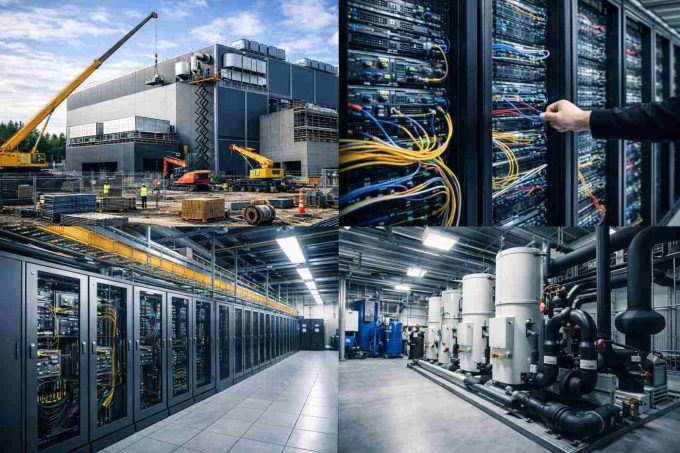

Initially, a data centre may appear comparable to any sizable commercial building. People working in construction will find the walls, floors, plant rooms and service risers familiar. Nonetheless, constructing a data centre is markedly dissimilar to any commercial project.
A data centre is created for the machines, power and cooling, continual operation, not to people or occupancy. All construction decisions impact operational uptime, efficiency and performance. Data centres are, therefore, a specialist field, and experience in commercial construction alone is usually not enough.
A data centre is an active technical system, not just a building.
The majority of commercial structures are static once built. Offices, stores and warehouses are designed to be occupied, fitted out and used with relatively predictable demands.
On the other hand, a data centre is a live.
It must run around the clock, 365 days a year, and usually there is no room for interruption. Essentially, the structure itself is incorporated into a broader digital system that supports servers, networks, and business-critical systems.
It impacts every aspect of the project, including the design of the structure and the installation, testing, and commissioning of services.
Mechanical and Electrical Loads are much Higher.
The MEP load is perhaps the biggest differentiator between data centres and traditional commercial buildings.
In an ordinary business plan.
* The building’s fabric takes priority over its mechanical and electrical services.
* Mechanical, electrical, and plumbing works may be a smaller percentage of the build cost.
Located within a data centre.
* MEP systems dominate the project.
* The infrastructure for power, cooling, and redundancy can account for much of the construction costs.
* Every system must be designed to be robust and scalable.
Data centres are power-hungry yet efficient.
* Power infrastructure with diverse voltage levels
* Uninterruptible power supply units and backup generators.
* Extra power sources for each essential equipment.
* Cooling systems with precision.
* Sophisticated regulation and supervision.
Installation of these systems must be done correctly, and their functioning must also not create any conflicts, even under heavy load.
Uptime is Essential
Commercial construction jobs typically don’t experience downtime during work. Buildings can be closed temporarily, tenants relocated, or operations suspended.
In data centre construction, unavailability is not an option.
Involvement in many projects.
* Increasing or Enhancing Live Infrastructure
* Development of fresh data halls at working campuses.
* The new systems are installed alongside the old systems.
It is necessary to detail construction sequencing, temporary works and changeovers to avoid disrupting live operations. Even the slightest interruption can lead to severe financial, operational, and reputational challenges for end users.
Contractors who require understanding.
* Practical working experience in a live environment.
* Strategies for construction phases.
* Strategies for reducing risk and planning fallback.
* Maintain close coordination with client IT and ops teams
The project commissioning is a project in itself.
Often in commercial construction, parties only consider commissioning as the last process to check various systems, hand over manuals and complete certification.
The commissioning stage is one of the most critical phases of data centre construction.
Systems must be verified before a data centre goes live.
* Conducted individual testing.
* Tested together.
* Tested with a load.
* Examine failure scenarios.
This encompasses.
* Simulation of a power outage.
* Starting generator with load
* Testing of UPS changeover.
* The performance of cooling at peaks.
* Testing of the integrated system
As construction progresses, commissioning may begin and will require collaboration with the client team, contractors, and equipment suppliers. The early stages of construction sequencing can be influenced by commissioning.
Design choices impact future operations in a broader scope.
In many commercial buildings, minor design inefficiencies may have negligible long-term consequences.
Decisions regarding design and construction can affect data centres.
* Power Usage Effectiveness (PUE).
* The cost of energy over the years.
* Safety and access to maintenance.
* Options for growth and expansion.
* Lifespan of Equipment.
To illustrate.
* Wrong airflow management can cause permanent increases in cooling costs.
* Insufficient containment can lower the density of servers.
* Having a limited plant space can limit future upgrades.
Thus, data centre construction requires early contractor involvement and close collaboration between design and build teams.
Adherence, conformity and certification are more complex.
Data structure initiatives often have particular standards and frameworks to follow.
* Standards for redundancy and resilience of industry.
* Buyer’s operational specifications.
* Security and Access Protocols.
* Objectives for Efficiency and Sustainability.
* Certifications like those linked to uptime tiers.
Meeting these needs requires a detailed understanding of construction and operational expectations, which general commercial contractors may not have.
Importance of Specialist Data Centre Builders.
The distinction between commercial construction and data centre construction is not merely technical, but also cultural.
Builders of data centres expertise.
* When thinking about property performance, avoid the approach of occupancy, not uptime.
* Comprehend that the project is mobilised by MEP systems.
* Prepare a construction schedule around live environments.
* Consider commissioning a main workstream.
* Plan and construct for expansion in the future, not only for transfer.
This methodology is the differentiator between standard and enhanced data centre design.
Designed for performance, not completion.
A data centre project is not deemed successful merely for finishing. The facility’s post-handover performance is the indicator of success.
The performance of the symbol is determined during the performance realisation stage by installation quality, coordination clarity, and team experience.
Data Centre Builders designs and builds mission-critical facilities that are reliable, efficient and scalable. We understand the differences in data centre construction and build accordingly.