
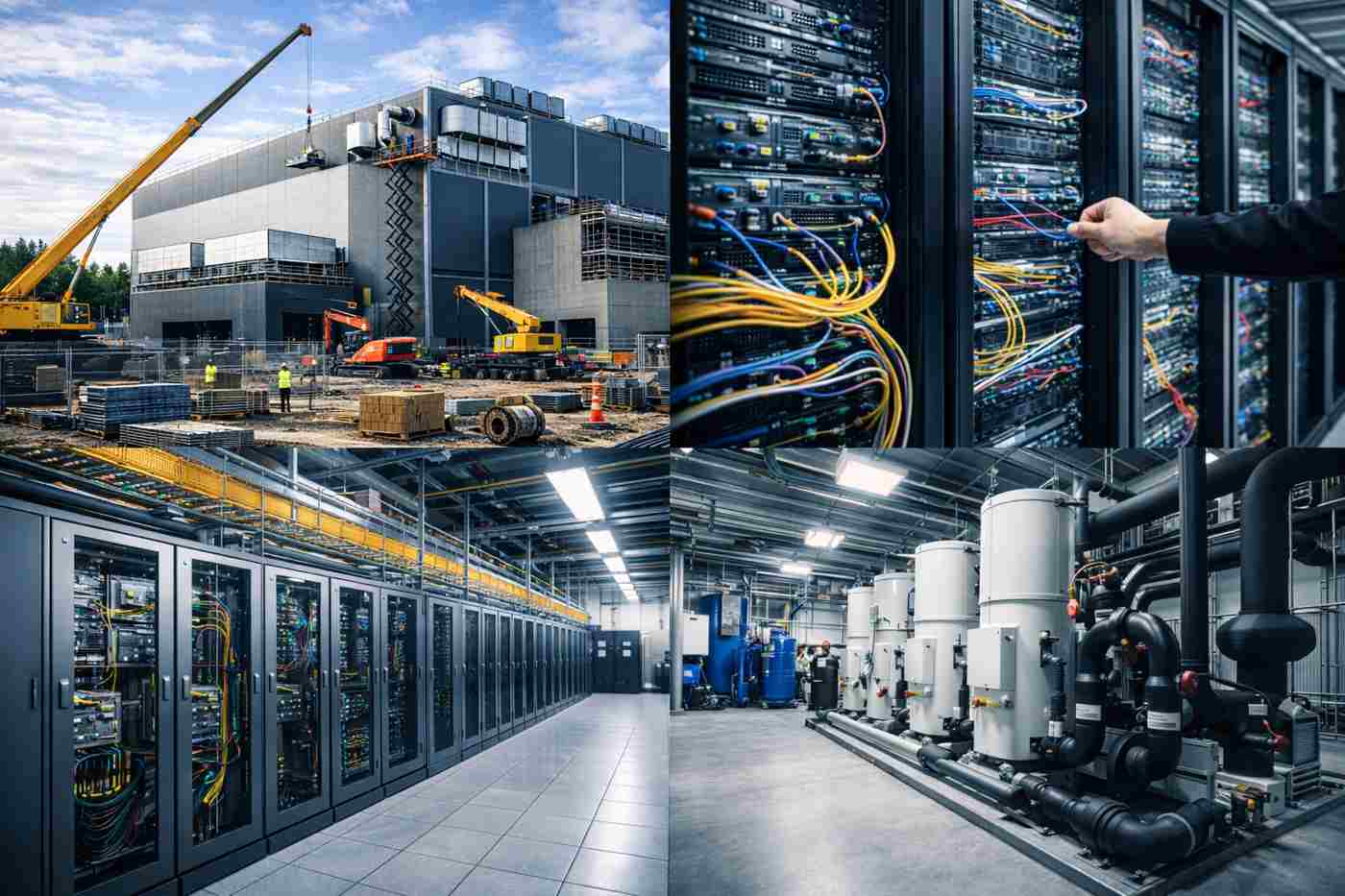
The facility must perform reliably once live, not at practical completion.
Building a data centre is a controlled process that integrates engineering, logistics, risk management and operational continuity right from day one.
The construction activities and procedures for developing the data centre constitute the data centre construction process. It necessarily involves a sequence of steps.
For preliminary services, the client or principal will appoint a data centre designer during initial scoping. The site for the data centre construction has been selected.
- Feasibility and Planning at Inception Phase
A data centre project’s success starts with a feasibility phase. This establishes the project’s strategic direction and confirms that the site, budget, and programme can deliver the performance required.
Main factors at this stage include.
The availability of power and the grid’s capacity. Currently assessing existing utility infrastructure, potential upgrades and lead times with the local DNO. Site restrictions. Conditions of accessibility, footprint, ground, planning restrictions and closeness to nearby assets. Operational specifications. Need for capacity, redundancy, uptime and scalability—feasibility of programme. Long-lead time items (for example, generators, switchgear and chillers) can dictate the overall programme timings.
Last-minute communication can lead to sub-optimal results. The stakeholders help identify risks before the processes are finalised. This eliminates the need for expensive future modifications.
- Development of design and technical coordination
The accomplishment of the feasibility study brings the project to the stage of detailed design.
While data centre design is architecture, it is so much more. The electrical infrastructure, mechanical HVAC systems, fire and life safety, security and access control, IT and networks requirements.
At this point, the construction team, specialist suppliers and engineers and designers need to integrate fully. All layouts must allow for appropriate airflow, maintenance access, containment strategies, future expansion, and respect the building’s physical limitations.
The choices made here will have an impact.
Data centre projects benefit from a collaborative approach to design and build.
- Planning and Procurement of Programs
As the design process evolves, different design issues must be given greater focus.
The lead time for specialist equipment for a data centre building is now longer than ever due to demand. There are also shortages of materials and labour.
The timelines for delivering the Generator and UPS. Production of switchgear. Purchase of chillers and plans. Just as crucial is logistics planning during modular or off-site fabrication. To prevent disruption, it is essential to sequence equipment correctly when plants are heavy.
Currently, the construction programme encompasses the design, purchase, installation and commissioning at one location.
- Building and assembling.
Constructing a data centre is more than just building a shell. The basic components are the structural and envelope installation. Most of the project will be for services.
Some of the key construction elements include.
Other over-site contractors carry out the main construction works, the plant rooms and their technical infrastructure. These contractors act as supply chain managers and carry out planning of work, risk management, and integration with the using organisation, main contractor, and sub-contractors. Primary structure and envelope, plant equipment and energy centres, raised Over-site contractor.
Performance is affected by the accuracy of cable route paths, airflow paths, penetration seal and containment.
Many data centre projects are delivered within live environments. As a consequence, construction will often take place alongside live operations. As a result, strict controls and detailed method statements require constant coordination with client operational teams.
- Testing and commissioning
Commissioning is a structured process which runs in parallel to construction; it is not a one-off event.
Testing should not only include the regular operation of systems in a data centre but also their failure cases. The situations may happen.
The tests mentioned above are only an indicative list, and many facility-specific tests for the new or upgraded system will also be planned.
These are some of the tests.
- Fat of major equipment.
- Conduct the SAT after installation.
- Testing of generators with a loadbank.
- UPS transition and backup.
The purpose of this is to prove that each system operates independently and also in conjunction, under normal and severe operating conditions.
In practice, it often lays out the order of construction – certain areas must be completed, sealed, and powered up in a controlled manner to ensure safe testing.
- Transfer and transition to operations.
The term handover indicates the cessation of construction and the commencement of live operations. The phase is crucial for a data centre.
A successful handover contains.
We prepare complete records and manuals along with training to ensure teams can operate smoothly.
The aim is to ensure that the client’s facilities and operations teams have a thorough understanding of the systems they will take over and manage from day one.
Support after handover is often required and becomes necessary during the operational phase, especially during system stabilisation and draughting.
Importance of understanding the process.
The construction of the data centre in each phase depends on the previous phase. Earlier miscalculations and shortcuts can cause minor glitches and downtime later on.
This is the justification for the need to build data centres.
- expert knowledge
- organised presentation of content
- Collaboration from the get go.
- Rigorously ordered commissioning.
We do not simply build buildings. The purpose of our design is to provide a facility that works as intended, long after construction.
Constructing with the Final Goal in Notion.
A data centre is necessary for big organisations to have in place one that hosts the computer system and its associated components, including anything the organisation depends on for information without fail. In the modern world, IT is considered the backbone of any media vehicle.
We take measures to minimize risk, protect uptime, and deliver value over the long term.