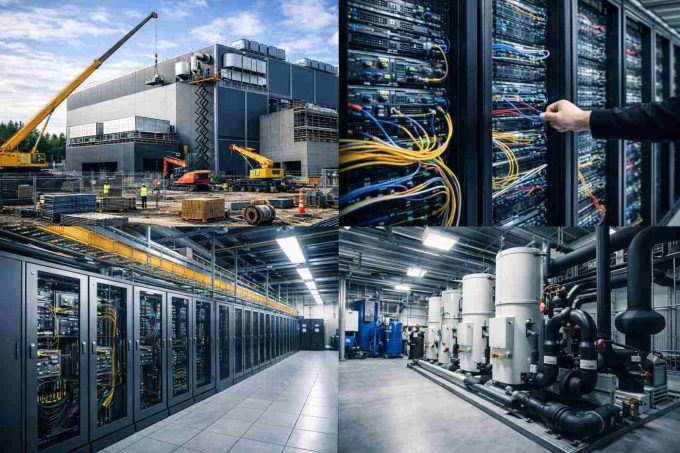
Data centres have become the backbone of the internet, cloud services, Power AI and many other services. However, these large servers generate significant heat as they operate 24/7, incessantly.
If you are planning to build a data centre in the UK, you might be in a difficult position to determine the right way for data centre heat management. Because the UK lacks clear guidelines for heat management in data centres.
While inefficient heat management may damage the powerful, costly machines, it may also harm the environment. So, what do you do to manage the heat? Simple, you plan from the construction stage.
Data Centre & Cooling – Why You Should Not Take it Lightly?
Did you know that in the UK, data centres use approximately 26 million litres of water each year to keep the facilities cooled? Besides, these facilities use approximately 30% to 50% of the total electricity used for cooling. These stats alone are concerning enough for you to consider data centre cooling seriously.
Moreover, if you consider the UK’s Net Zero target, data centre cooling facilities can be a troubling factor in achieving it. Reducing the energy consumption or water needed to keep the servers cool is not a piece of cake, given that these data centres power online activities. You need proper planning and an innovative approach to resolve the issue.
Let’s take the example of Queen Mary University of London, which, along with Schneider Electric, has designed the university data centre to provide heating and hot water for all student accommodation and university buildings. The waste heat is used to heat water and also helps cool the servers.
Data Centre Cooling & Types
Maintaining the correct temperature in data centres is crucial to ensure optimal server performance. You will also have to consider the risk posed by high temperatures in data centres. Generally, the temperature is maintained between 18 and 27 degrees Celsius, and excess heat is removed through several methods.
Below are the most common methods of cooling data centres:
Air Cooling
In this method, a powerful air conditioning system is used to maintain the temperature. Servers are arranged in two rows: hot aisles and cool aisles. The front of the servers faces the cool aisle, where underground ducts supply cool air. On the other hand, the back of the servers faces the hot aisle, where vents extract hot air from the servers.
In such an air-cooling set-up, Precise Air Conditioning (PAC) units are used to maintain humidity and temperature.
Liquid Cooling
This is a relatively new form of data centre cooling system that uses liquid coolant to extract heat from servers. In immersion cooling, the server’s critical components are submerged in a nonflammable coolant. As the liquid heats up, it evaporates, removing heat from the source.
Evaporative Cooling
Unlike a traditional air conditioning system, an evaporative cooling system uses water to lower the data centre temperature. It uses absorbent wet cooling pads to remove hot air from the centre’s interior. As hot air passes through wet cooling pads, water evaporates, removing heat from the air. The cold air is then recirculated into the data centre to maintain the indoor temperature.
However, this technique may not be suitable for all types of data centres as the circulated air carries moisture, increasing the humidity level inside.
Consider Cooling & Power Efficiency from the Construction Stage
If you do not plan for cooling and power efficiency from the construction stage, you may not end up with a great facility. Depending on the type of cooling you want to install for the data centre, the layout should be designed accordingly.
Even if you have something innovative planned, like Queen Mary University, integrate it into the design from the construction stage. If you change the plan later, it would only increase the cost and result in product wastage.
Facility Design and the UK Climate
If you want your facility to reduce its cooling energy consumption by up to 80%, you should design it to use a free-cooling approach. In this method, the data centre is designed to draw in cold outside air to mitigate heat issues.
This method is widely used in Northern Europe and the Nordic regions. However, you may not rely on free cooling year-round in the UK, but it can be effective during winter.
If you plan to use a hybrid cooling approach (free cooling and liquid or air cooling), the facility needs to be carefully designed. Contact Data Centre Builders to build your data centre with state-of-the-art facilities.
Conclusion
Regardless of the cooling system you want to install in the data centre, you will have to incorporate the design from the construction stage. A data centre with an air-cooling system will have a different floor layout than a data centre with a liquid-cooling system. Even if you want a hybrid cooling system, the facility will be designed accordingly.
Get in touch with Data Centre Builders today and let us know how you have imagined your data centre. We will make it happen.